Rock has always had a complicated relationship with the female body. From the moment women started fronting bands, the industry found ways to put their sexuality to work — sometimes for the artist, often for everyone else. The story isn’t clean. It isn’t one thing. It’s Lee Aaron being packaged as Canada’s “Metal Queen” before she fully understood what that label would cost her. It’s Maria Brink stripping down on her own terms and daring you to call it exploitation. It’s Cherie Currie, a teenager, in photos that never should have been taken. Between those extremes lies a messy, fascinating history of women in rock who bared their bodies — and what that choice, or lack of one, actually meant.
Lee Aaron
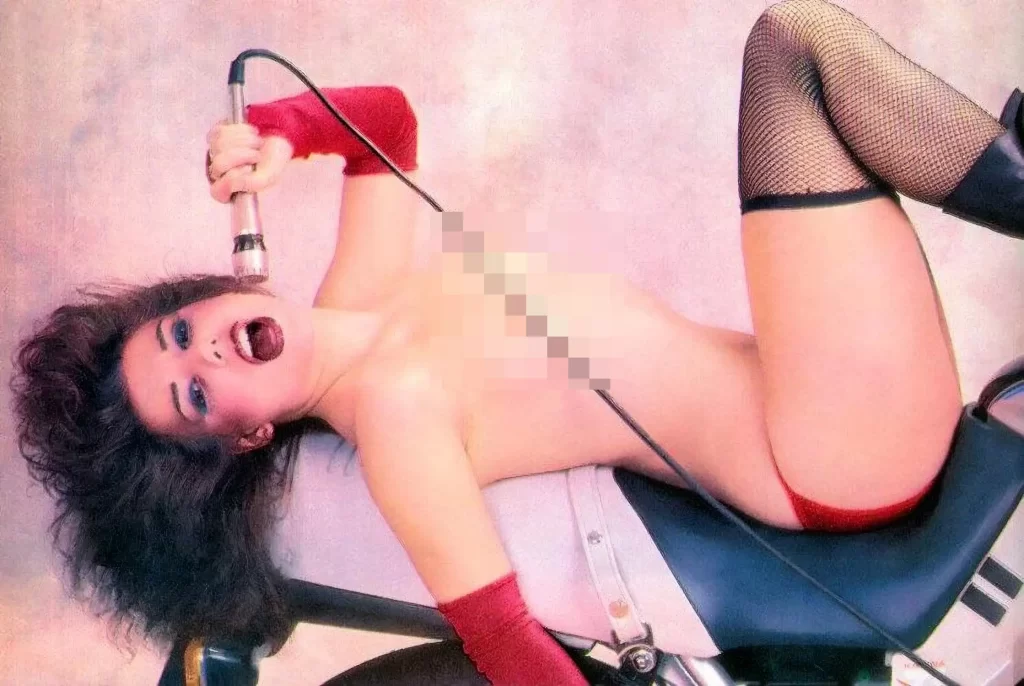
Lee Aaron Oui Magazine
Era / Genre: Canadian Hard Rock / “Metal Queen”; early‑1980s
Career Context at the Time:
Aaron was being marketed as Canada’s “Metal Queen,” a sexed-up counterpart to male metal frontmen.
What Happened:
In March 1983, she appeared in Oui magazine in a topless/nude pictorial, including a cover tease and an interior layout used to promote her Metal Queen album. Contemporary coverage and later interviews confirm the shoot.
Agency & Intent:
Aaron has acknowledged the shoot as a promotional stunt orchestrated by management. At the time, she agreed, seeing it as part of breaking through in a male-dominated genre, but later expressed frustration that it cemented a one-dimensional, sexualized image.
Public & Industry Reaction:
The layout got attention in rock media, but also led some to discount her as a serious musician.
Career Impact:
The “Metal Queen” image brought visibility but boxed her in. Aaron eventually shifted genres (toward jazz and more adult-contemporary material), in part to escape the constraints of that early branding.
Notes / Clarifications:
A textbook case where authorized nudity “worked” commercially but complicated the artist’s long-term creative trajectory.
Lorraine Lewis (Femme Fatale, Vixen)
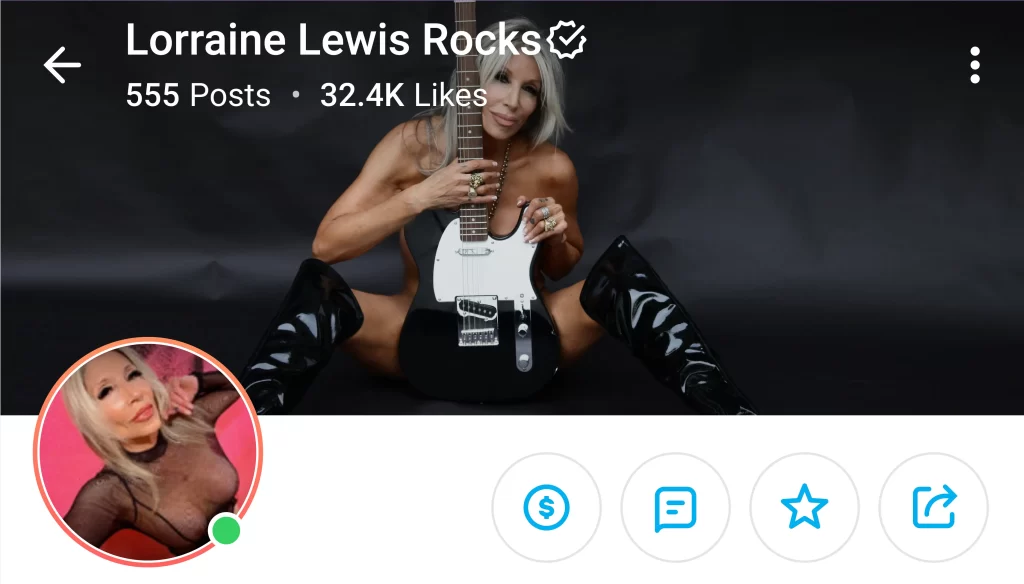
Lorraine Lewis’s OnlyFans page
Era / Genre: Hair Metal / Melodic Hard Rock; 1980s–present, with OnlyFans era beginning 2025
Career Context at the Time:
Lewis fronted Femme Fatale in the late ’80s and later became vocalist for Vixen (2019–2024). In 2025, at age 66, she launched an OnlyFans presence.
What Happened:
In January 2025, Lewis announced an OnlyFans account (OnlyFans.com/LorraineLewisRocks), explicitly promising “naughty” and near-nude content. Coverage emphasized that she was choosing to “bare it all” in her sixties, following the path of other celebrities like Carmen Electra and Drea de Matteo.
Agency & Intent:
Entirely artist-driven. Lewis said she had wanted to join OnlyFans “for a very, very long time” and framed it as reclaiming fun and sex appeal on her own terms: “I’ve always been unpredictable… It’s time to go for it, have some fun and show off my wild side.”
Public & Industry Reaction:
Metal blogs and mainstream outlets responded with a mix of nostalgia, curiosity, and ageist snark. Many fans applauded her autonomy and refusal to “age out” of sexuality. The Hard, Heavy & Hair Show and its host Pariah Burke were especially supportive of Lewis, signing up as one of her first subscribers after her OF debut.
Career Impact:
Beyond new revenue, the move repositioned Lewis as a veteran rocker unapologetically owning her image in the subscription era—an inversion of the old label-controlled pinup model.
Notes / Clarifications:
This is perhaps the clearest example of a legacy hair-metal figure leveraging modern platforms to control both nudity and narrative.
Maria Brink (In This Moment)
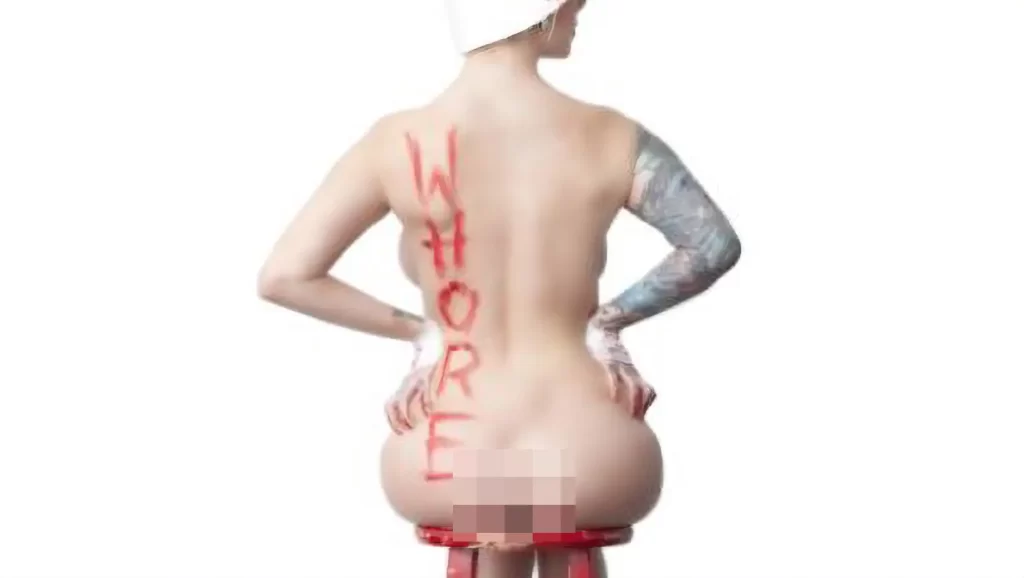
Maria Brink on the cover of “Whore”
Era / Genre: Modern Metal / Hard Rock; 2013
Career Context at the Time:
Coming off the success of Blood (2012), In This Moment were moving from metalcore-adjacent into theatrical, concept-driven hard rock.
What Happened:
For the single “Whore,” Brink posed fully nude from behind in official promo art: her body bare, “WHORE” written down her spine, a dunce cap on her head. The imagery was used in single artwork, live stage visuals, and promotional materials.
Agency & Intent:
Brink framed the nudity as an explicitly feminist re-appropriation. She redefined “WHORE” as an acronym—Women Honoring One another Rising Eternally—and stated she posed nude “to evoke a raw vulnerable emotion” and to confront the stigma around female sexual agency.
Public & Industry Reaction:
Coverage in metal and rock press highlighted the intent as much as the nudity. Some conservative fans dismissed it as “just more gimmick,” but many praised it as a bold, conceptually coherent move.
Career Impact:
The “Whore” imagery became iconic for the band, reinforcing their shift into conceptual theater metal and cementing Brink’s status as an aesthetic architect, not just a frontwoman.
Cherie Currie (The Runaways) – Contested / Exploitative Case
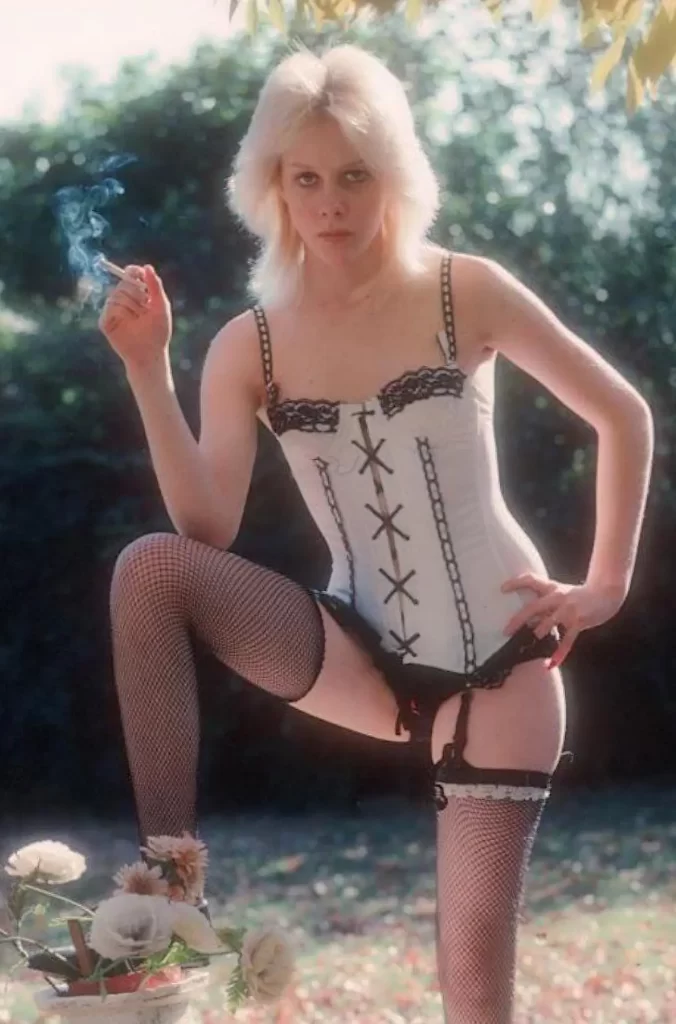
Cherie Currie in The Runaways publicity photo
Era / Genre: Proto‑punk/Hard Rock; late‑1970s
Career Context at the Time:
Currie was the teenage frontwoman of The Runaways, a band heavily shaped and controlled by manager Kim Fowley.
What Happened:
In 1977, she was photographed nude by Japanese photographer Kishin Shinoyama. The images, shot when she was around 16–17, have circulated as “art” photos in books and online.
Agency & Intent:
Numerous fan discussions and secondary accounts suggest Currie was not fully aware of how the images would be framed, and that Fowley orchestrated the shoot in ways that deepened divisions within the band. Currie has spoken extensively about Fowley’s abuse; the Shinoyama images fit a broader pattern of exploitation rather than empowered self-presentation.
Public & Industry Reaction:
At the time, the photos were not widely known in the West. They have since become symbolic of how young women in rock could be sexualized and controlled by older male gatekeepers.
Career Impact:
The shoot and its aftermath contributed to tensions that helped break up The Runaways. For Currie, they are part of a traumatic chapter, not a chosen brand move.
Notes / Clarifications:
This is not a clean “authorized nudity” example and should be treated as a cautionary case about power imbalance and consent.
Carla Harvey (Butcher Babies / Lords of Acid / The Violent Hour)
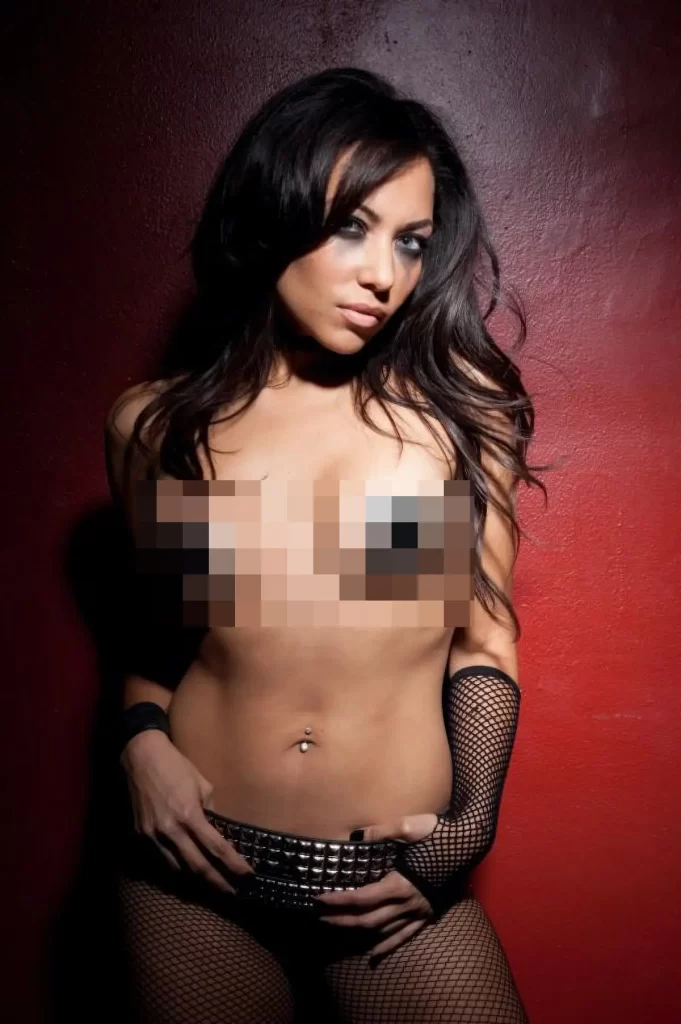
Carla Harvey in her Butcher Babies days
Era / Genre: Modern Groove/Thrash Metal; 2000s–2010s
Career Context at the Time:
Before co-fronting Butcher Babies, Carla Harvey worked in adult-oriented media; later, early Butcher Babies shows were notorious for topless/nipple-tape performances.
What Happened:
- Under the alias Bridget (Bridgette) Banks, Harvey did nude modeling for adult sites and appeared in adult-oriented layouts.
- She worked as a nude “anchorwoman” for Playboy TV’s The Weekend Flash, appearing in over 100 episodes—her first big on-camera gig.
- Early Butcher Babies shows featured Harvey and Heidi Shepherd performing topless with only nipple tape, a Wendy O. Williams–inspired shock-rock homage.
Agency & Intent:
Harvey has spoken openly about choosing those jobs, then consciously leaving the adult industry when it no longer aligned with her values. She frames both the Playboy TV work and the nipple-tape era as part of her personal exploration of sexuality and performance—choices she later contextualized, but does not deny.
Public & Industry Reaction:
Metal fans and media frequently reduced Butcher Babies to the nipple-tape gimmick, often ignoring their musicianship. Harvey and Shepherd have both acknowledged that while they have no regrets, the gimmick made it harder to be taken seriously.
Career Impact:
The imagery initially helped the band stand out, but later proved a liability. Harvey has broadened her identity through comics, novels, grief work, and more mature musical projects.
Notes / Clarifications:
Harvey’s case highlights a transition: from being commodified in adult media to consciously deploying (and then retiring) sexualized imagery within a metal context on her own terms.
What ties all of these stories together isn’t nudity itself — it’s the question of who’s holding the camera, who’s signing the contract, and who wakes up the next morning owning the image. The industry has changed. Labels have loosened their grip, OnlyFans has handed artists a direct line to their audience, and women like Lorraine Lewis are rewriting what it looks like to be a rock icon in your sixties. But the old dynamics haven’t disappeared — they’ve just gotten subtler. The difference between empowerment and exploitation has never been about how much skin is showing. It’s always been about power. And in rock, that fight is nowhere near finished.